

A bandgap reference, an error amplifier, and an output transistor in one three-pin device. It's still a staple after nearly five decades.
When Texas Instruments introduced the TL431 in the late 1970s, it wasn’t framed as a revolution, but as a smarter replacement for temperature-compensated Zener diodes, a cheap way to get an accurate 2.5-V reference without fuss.
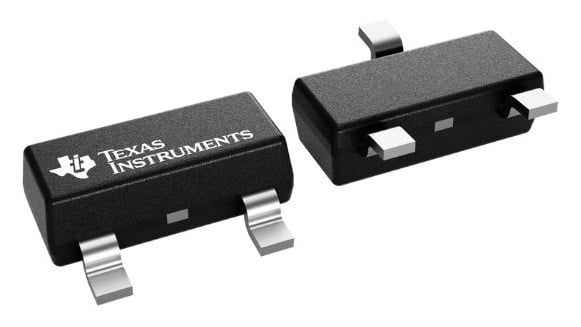
The TL431 is often called a "programmable Zener." Image used courtesy of Texas Instruments
But designers quickly discovered that this little adjustable shunt regulator could do far more. It became the standard error amplifier in isolated switch-mode power supplies, the heart of thousands of feedback loops, and a general-purpose analog building block that kept showing up in circuits where no Zener ever could.
The TL431 ended up defining how low-cost power supplies regulate voltage. It also became one of the most cloned, repackaged, and repurposed analog devices ever produced, quietly woven into the fabric of everything from CRT monitors and ATX supplies to industrial controllers and automotive ECUs.
A Bandgap Reference With Teeth
Inside the TL431 (datasheet linked) is a classic bandgap reference scaled to about 2.495 V, an internal op amp that compares the REF pin against that reference, and a transistor that can sink up to 100 mA from the cathode. In effect, it’s a precision comparator with gain, wrapped around a reference good enough to hold regulation across temperature and production spread.
Short REF to the cathode and the TL431 behaves like a sharp, low-noise 2.5-V Zener substitute. Add two resistors, and it becomes a programmable reference up to roughly 36 V. Tie its output to an optocoupler LED, and it turns into a full feedback controller for isolated flybacks. The charm is that all of this happens without configuration registers or delicate bias networks. Its internal pole gives it a predictable bandwidth, and its output stage can swing from microamps to tens of milliamps with impressive consistency.
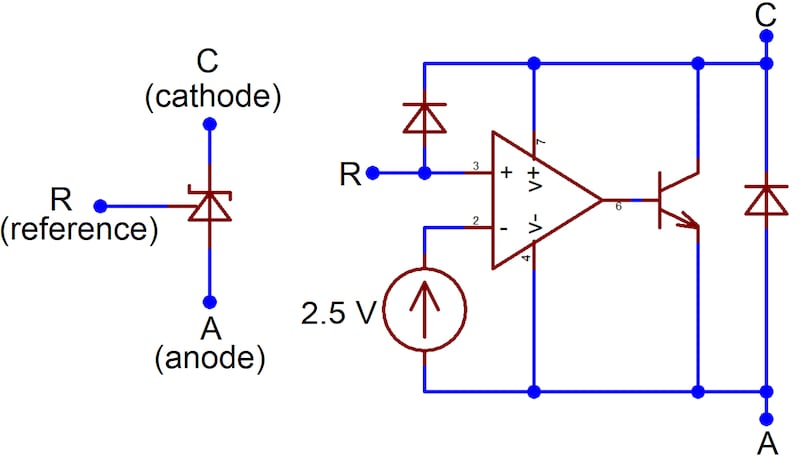
A simplified schematic of the TL431. Image used courtesy of Wikimedia Commons (Public domain)
Like many late-1970s analog ICs, the TL431 was engineered with generous margins. Minimum operating current hovered around 1 mA, but above that, it behaved with surprising linearity. TI and other manufacturers soon offered tighter grades of +/-1% and +/-0.5% reference accuracy, which ensured that the device could anchor voltage loops in consumer SMPS designs without resorting to expensive precision references.
And because the REF pin’s input current sits in the microamp range, the divider that sets the output voltage rarely affects accuracy. In an era when cheap supplies needed stability without extra components, that was enough to turn the TL431 into the default choice.
The SMPS Workhorse
By the mid-1980s, offline flyback converters were everywhere. TVs, VCRs, PC power supplies, and the emerging universe of wall-wart adapters. Most of them shared a familiar block on the secondary side: a TL431 driving an optocoupler wrapped in a small RC network that shaped the feedback loop.
The part excelled here because it combined several necessary functions in one place. Its reference was stable, its internal amplifier had enough gain to enforce tight load regulation, and its output transistor could directly modulate an optocoupler LED without external buffering. Designers only needed a compensation capacitor, a resistor or two, and a sense divider. That simplicity translated into millions of sockets.

Transistor-level schematic. Image used courtesy of Wikimedia Commons (Public domain)
The TL431’s internal compensation, however, was also the source of its most notorious oscillation quirk with the wrong capacitive load. Small ceramics on the cathode could shift the dominant pole and shave phase margin to nothing, especially at light loads where the device sat near its minimum operating current. Application notes quickly circulated recommending a small series resistor between the TL431 and the optocoupler or output capacitor, adding a zero, and keeping the loop civil.
Even with these caveats, the part remained forgiving. As long as the cathode current stayed above its minimum and the REF divider was biased sensibly, the overall loop behaved predictably, even in cheap supplies with wide tolerances, poor layout, or cost-driven compromises.
Beyond the Feedback Loop
Once engineers realized the TL431 could act as a Zener with gain, its uses expanded well beyond power-supply regulation.
It became a natural fit for over-voltage protection, driving SCRs or MOSFETs when a threshold was crossed. It served as a precision current sink when paired with a sense resistor. It doubled as a window comparator in battery chargers and instrumentation. And in linear regulators, the TL431 often stood in for a reference and error amplifier, controlling an external pass transistor to form a simple three-terminal regulator.
Low-voltage variants like the TLV431 and LMV431 extended the device into 1.24-V domains and reduced the minimum operating current to the tens of microamps. Automotive-rated TL431-Q1 versions broadened production into harsh environments. Dozens of vendors produced pin-compatible clones, some performing nearly identically, others offering noticeably different gain or compensation characteristics, enough that power-supply designers sometimes stuck with a single source to avoid re-qualifying control-loop stability.
Despite the sea of variants, the architecture stayed the same. The REF pin was always the reference input, the anode always the ground-side terminal, and the cathode always the business end. That continuity kept the TL431 relevant even as switching controllers and topologies evolved around it.