
New microcontrollers from ST, Infineon, and Nuvoton highlight how the MCU market is expanding sideways rather than moving along on a general industry standard for performance.
STMicroelectronics, Infineon Technologies, and Nuvoton have each announced new microcontrollers that target different parts of the embedded market.
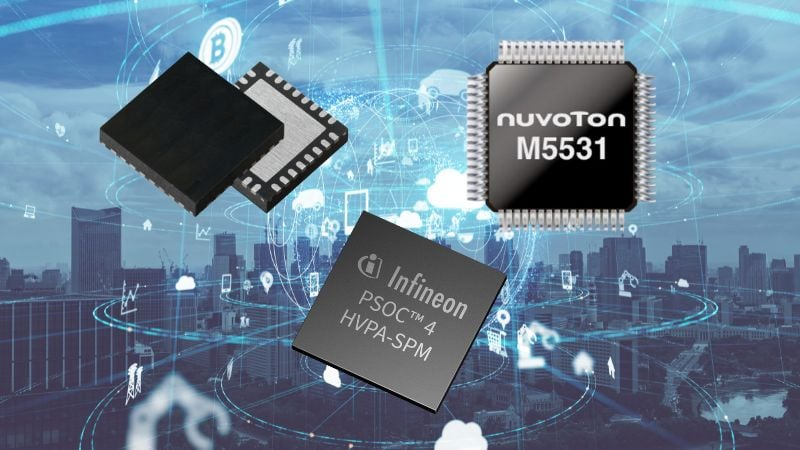
ST’s STM32WL3RK8 targets low-power wireless endpoints, with sub-GHz RF integration and operating modes aimed at long battery life in remotes and simple sensor nodes. Infineon’s PSOC 4 HVPA-SPM 1.0 is built around high-voltage battery pack monitoring and functional safety requirements for EV platforms. Nuvoton’s NuMicro M5531 aims for higher compute capability, larger memory, and heavier signal-processing workloads with its Cortex-M55 core.
Together, these three releases show how modern MCUs are being shaped by application needs rather than a single performance curve. Power, safety, wireless integration, and processing demands now drive designs into separate tracks.
ST's Battery-Saving Wireless MCUs
From a hardware standpoint, the three devices diverge immediately at the core level.
The STM32WL3RK8 (datasheet linked) is built around a Cortex-M0+ running up to 64 MHz, paired with 64 KB of flash and 8 KB of SRAM. Its defining feature is the integrated sub-GHz RF transceiver, which supports multiple modulation schemes including 2-FSK, 4-FSK, OOK, and ASK across regional ISM bands around 315 MHz, 433 MHz, and the 800–900-MHz range.

Block diagram of the STM32WL3Rxx. Image used courtesy of STMicroelectronics
Power modes are aggressive, with sub-µA current in deep sleep and nA-scale shutdown, along with six independent wake-up pins. The peripheral set is modest and typical for low-power control and wireless nodes, with basic timers, SPI, I²C, and UART.
Infineon's MCU for High-Voltage Li-ion Battery Management in EVs
The PSOC 4 HVPA-SPM 1.0 also uses a Cortex-M0+ core but shifts nearly all of its hardware emphasis toward high-voltage battery monitoring. It integrates high-resolution delta-sigma ADCs for current and voltage sensing, on-chip isolation measurement, and support for electrochemical impedance spectroscopy. Memory resources remain small by general MCU standards, with 128 KB of program flash, 16 KB of data flash, and 8 KB of SRAM. Unlike the ST part, its communication focus centers on automotive networking, including CAN-FD and an ISO-UART daisy-chain interface for stacked battery modules. Functional safety is central to the design, with ISO 26262 ASIL-D alignment driving both the analog front end and the digital diagnostics.
Nuvoton's MCU for High-Performance Computing and IoT Security
At the opposite end of the spectrum, Nuvoton's NuMicro M5531 (datasheet linked) is built on a Cortex-M55 core running up to 220 MHz, with vector extensions for DSP-class workloads.
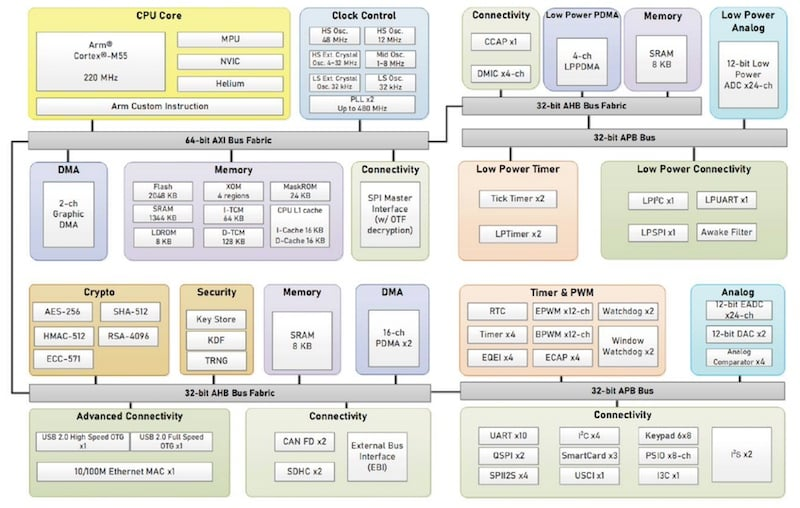
Block diagram of the NuMicro M5531, including a Cortex-M55 core for high-performance DSP-class workloads. Image used courtesy of Nuvoton
It carries megabyte-class flash and SRAM, placing it in a different memory tier than the other two devices. Its peripheral set is also far broader, extending to USB, Ethernet, CAN-FD, SDHC, high-speed serial interfaces, and a full security subsystem with hardware crypto and secure boot. Unlike the ST and Infineon devices, it includes neither an RF transceiver nor a high-voltage analog front end, instead positioning itself as a high-throughput embedded processor for data-heavy edge applications.
MCUs to Accommodate Both Low-Power and Performant Systems
Taken together, these three devices highlight how the MCU market is expanding sideways rather than moving along a general industry standard for performance. On the low end of the power spectrum, demand for long-life wireless endpoints continues to grow across consumer electronics, building automation, and asset tracking, all of which favor highly integrated sub-GHz solutions like the STM32WL3RK8. At the same time, electrification is pushing new requirements deep into the vehicle, where battery management has become both a safety and a system-architecture problem.
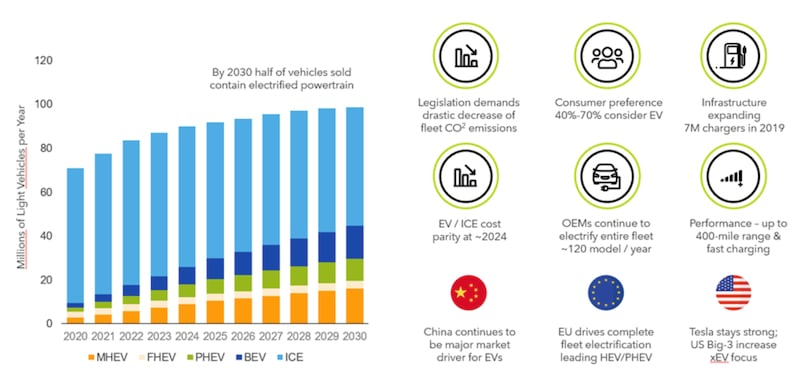
Chart showing the increasing electrification of vehicles by 2030. Image used courtesy of NXP
Devices like the PSOC 4 HVPA-SPM 1.0 reflect how monitoring, communication, and diagnostics are being pulled directly into the battery pack as zonal control spreads through EV platforms.
On the performance side, the rise of edge analytics, sensor fusion, and security-aware embedded systems is driving interest in higher-throughput MCUs built around cores like the Cortex-M55, with large memory footprints and hardware acceleration, as seen in the NuMicro M5531.
Rather than competing directly, parts like these tend to grow alongside the application spaces they were built for. Low-power wireless nodes scale with smart home and industrial sensing. Battery-pack monitors scale with EV production. High-performance MCUs scale with edge computing and robotics. This separation of roles points to a market where specialization, not generalization, is increasingly the driver of demand and volume production.