
Developed in the mid-1970s, National Semi’s LM386 collapsed a complete audio output stage into a single DIP-8 package running off a 9-V battery—and it became the first amplifier most hobbyists ever built.
National Semiconductor introduced the LM386 in the mid-1970s as a low-voltage audio power amplifier for battery-operated consumer products. The chip put a complete Class AB output stage into an 8-pin, dual-in-line package, with an internally set gain of 20, ground-referenced inputs, a self-biasing output, and a quiescent current of just 4 mA. That meant it could drive a speaker from a 9-V battery with as few as two external components.
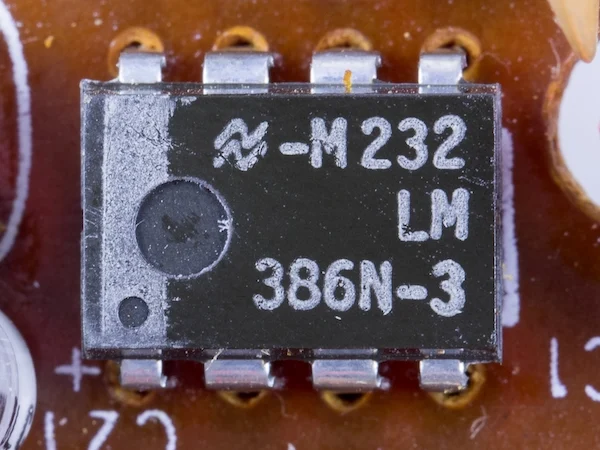
An LM386 in a DIP-8 package. Image used courtesy of Raimond Spekking via Wikimedia Commons (CC BY-SA 4.0)
Nearly 50 years later, it remains in active production at Texas Instruments (which acquired National Semiconductor in 2011) and is second-sourced by Unisonic, JRC/NJM, and generic fabs worldwide, with no announced end-of-life.
Lin Topology in Eight Pins
The LM386's internal circuit (datasheet linked) follows the Lin topology that was already standard in discrete audio amplifier design: a differential input stage, a voltage amplifier stage, and a complementary push-pull output. It compressed that entire signal chain into a package smaller than a fingernail.
The input stage uses a PNP emitter-follower pair feeding a long-tailed differential amplifier. Two 50-kΩ resistors set the input impedance and provide the ground-reference path, allowing the inputs to accept signals at or near ground potential without external biasing.
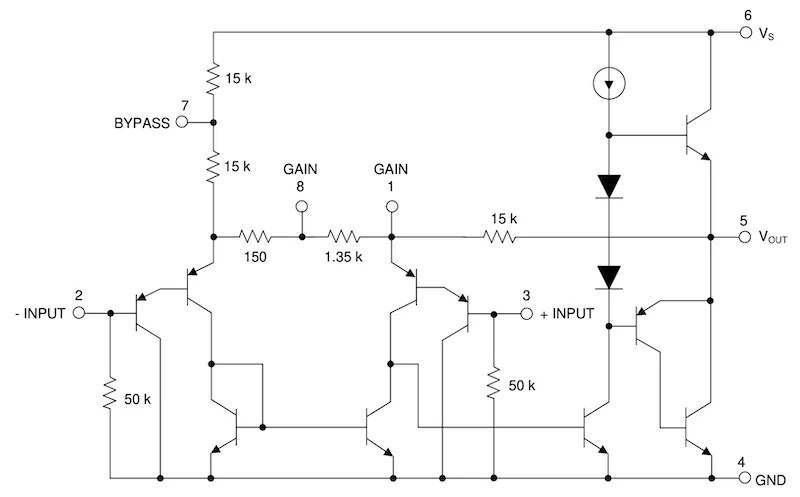
Schematic of the LM386. Image used courtesy of Texas Instruments
The gain network sits between pins 1 and 8: an internal 1.35-kΩ resistor in series with a 150-Ω resistor fixes the default voltage gain at 20 (26 dB). Placing a capacitor across pins 1 and 8 bypasses the 1.35-kΩ resistor and pushes the gain to 200 (46 dB), while a resistor in series with that capacitor sets any value in between. The output stage is a complementary push-pull pair biased into Class AB, capable of driving loads from 4 Ω to 32 Ω . The output automatically biases to half the supply voltage, eliminating any need for external DC biasing.
Three variants cover the power range: the LM386N-1 delivers 325 mW, the LM386N-3 reaches 700 mW, and the LM386N-4 tops out at 1 W. All three run from supply voltages between 4 V and 12 V (up to 18 V for the N-4), and all draw roughly 4 mA at idle. At 6 V, the quiescent power consumption is 24 mW.
Clock Radios to Cigarette-Pack Guitar Amps
National Semiconductor's original datasheet listed the target applications as AM-FM radio amplifiers, portable tape player amplifiers, intercoms, TV sound systems, line drivers, ultrasonic drivers, and small servo drivers. These were products where a discrete transistor output stage was overengineered for the required power level, and where considerations such as battery life and board space outweighed the need for audio fidelity. The LM386 gave designers a drop-in solution: one IC, one output coupling capacitor, one power-supply bypass cap, and a speaker.
The chip's second and longer life came in the DIY community. Bruce Zinky, an American electronics engineer who headed Fender's amplifier custom shop, designed the Smokey Amp in the early 1980s: a complete guitar amplifier using one LM386 and two capacitors, built to fit inside a cigarette pack. The design had no controls at all, with volume and tone set entirely from the guitar's own inputs.
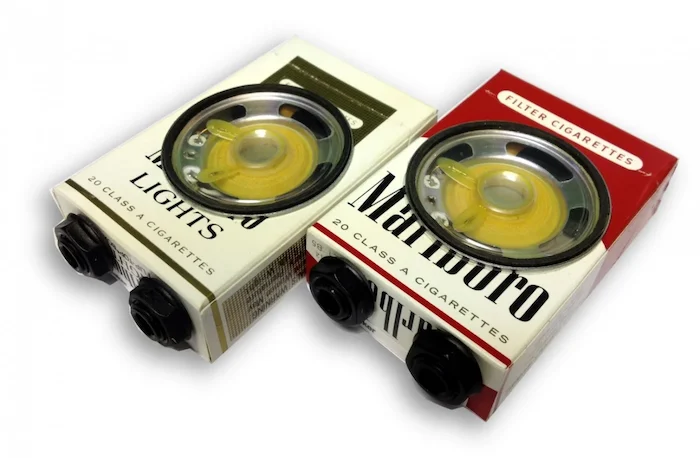
The Smokey Amp, designed by Bruce Zinky. Image used courtesy of Audiofanzine
Zinky improved it for commercial production in the 1990s, and the Smokey Amp went on to become one of the most widely cloned circuits in hobbyist electronics. The "Little Gem" and "Little Gem MkII" are direct derivatives, and dozens of other LM386-based mini amps, fuzz circuits, code-practice oscillators, and Arduino speaker drivers have followed.
Class D
On paper, the LM386 should have been obsolete years ago. Modern Class D amplifiers like Diodes Incorporated's PAM8403 deliver 3 W per channel in stereo from a 5-V supply, with no output filter, lower distortion, and a fraction of the board space. TI's own application engineers recommend newer parts, such as the LM4864 and TPA4861, for new designs. The LM386's distortion at full power is a published 10% THD, which is high enough that even its datasheet acknowledges the output is clipping.
Yet TI still manufactures the LM386 in DIP-8, SOIC-8, and VSSOP-8 packages, Unisonic and JRC still ship their own versions, and Mouser and Digi-Key still stock it in volume. The part persists largely because it requires no supporting ecosystem. There’s no firmware, no configuration register, no filter design, no minimum decoupling capacitor network. It works with a soldering iron, a capacitor, and a battery. That’s the same reason National Semiconductor designed it in the first place, and it turns out to be more durable than the performance specifications ever were.