
While wireless charging has become standard in large consumer devices, shrinking that technology down into products like smart rings creates a different set of problems. Space disappears quickly. Coil sizes become difficult to work with. Traditional Qi charging systems weren't designed with devices that small in mind.
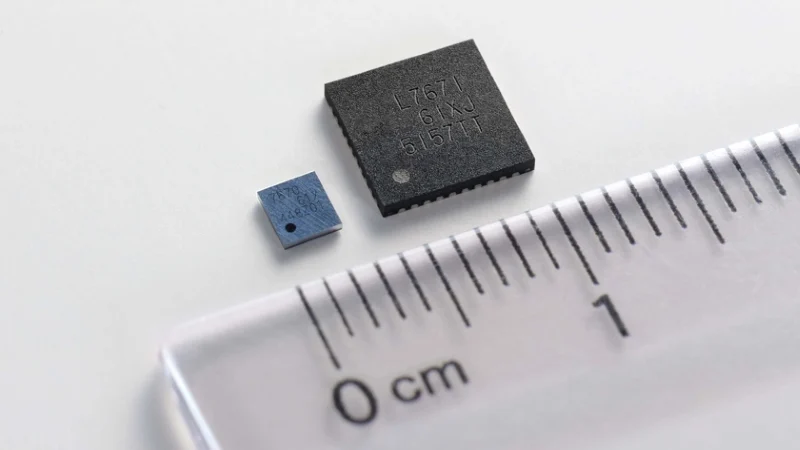
Rohm's ML7670 receiver IC is designed for ultra-compact wearable devices where space and antenna size are heavily constrained.
That’s the gap Rohm is targeting with its new ML7670 and ML7671 wireless charging chipsets. The new receiver and transmitter pair is built around NFC wireless power technology operating at 13.56 MHz. Unlike conventional Qi systems, which often require larger coils to transfer power effectively, the higher-frequency NFC approach supports much smaller antennas. That matters in wearables where every millimeter counts.
Why NFC Makes More Sense for Smaller Wearables
Smart rings are driving a lot of this shift. Wired charging is awkward on devices that small, but fitting a traditional Qi coil into a ring-shaped form factor is equally difficult. NFC-based charging changes the equation because the higher operating frequency supports antenna miniaturization. That makes it easier to build reliable wireless charging into devices with very limited internal space.
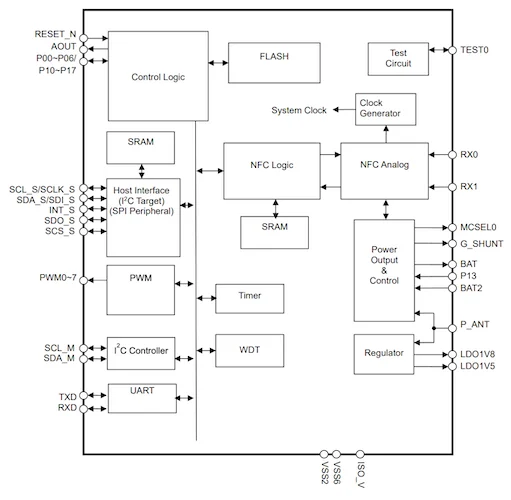
Block diagram of the ML7670.
Rohm designed its new chipset specifically around that constraint. The ML7670 receiver supports up to 250 mW of wireless power transfer while fitting into a compact 2.28 mm × 2.56 mm WL-CSP package. The transmitter side, ML7671, handles wireless power delivery and communication while operating directly from a 5-V USB power source. The company says the receiver achieves up to 45% power transfer efficiency in the 250-mW range, which is important in wearables where thermal limits and battery size leave little room for wasted power.
Reducing External Components
A major part of the design focuses on integration. Instead of requiring a large number of external support components, the chipset pulls many of those functions directly into the ICs themselves.
Switching MOSFETs used for supplying power to charging circuits are built in, along with charging control functions, LDO support, communication control, and monitoring features.
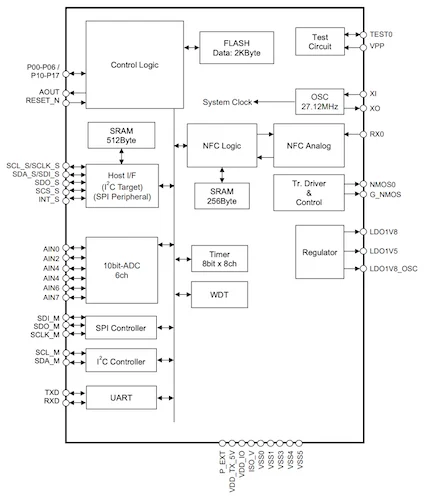
Block diagram of the ML7671.
The receiver also integrates a 10-bit SAR ADC for power monitoring along with NFC communication capabilities. On top of that, the chipset supports NFC Forum Type F technology, enabling functions such as Bluetooth pairing through touch-based interaction. All of that reduces board complexity in devices with extremely limited PCB space.
The Significance of the MCU-Free Design
One of the platform's more important features is what Rohm calls its MCU-free architecture. The firmware required for wireless power delivery is embedded directly into the IC. That removes the need for a separate host MCU to manage charging behavior and communication control.
In practice, that simplifies both hardware and software design. Developers don’t need to allocate additional board space for a dedicated controller, and they also avoid some of the firmware development overhead that would normally come with implementing wireless charging management externally. For small wearable products, those savings add up quickly. At the same time, the chipset still offers flexibility. Both devices include I2C interfaces that allow configuration updates from an external MCU if needed.
Built Around Compact Devices
The intended applications are clearly centered around ultra-small electronics. Smart rings are the obvious example, but the platform also targets smart bands, wireless earbuds, hearing aids, stylus pens, smart glasses, and other compact battery-powered devices.
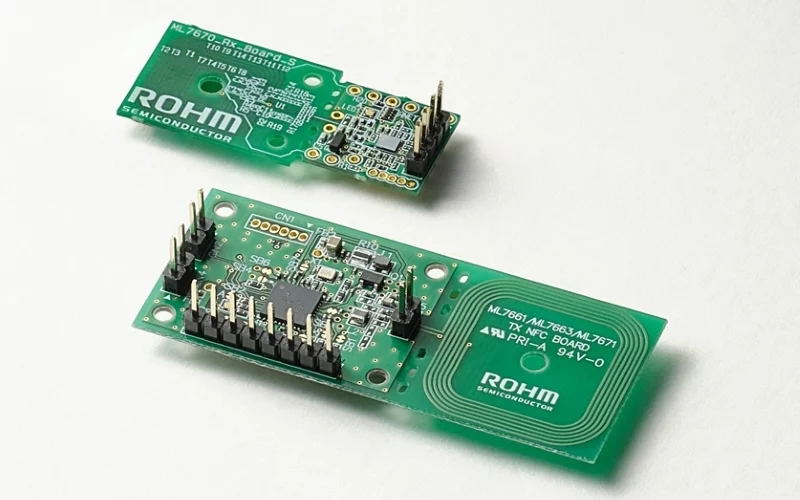
Rohm’s evaluation boards demonstrate the compact NFC wireless charging architecture used for integrating receiver and transmitter ICs into small wearable devices.
Rohm says the chipset has already been adopted in the SOXAI RING 2, a Japanese-developed sleep-monitoring smart ring that combines NFC charging with optical sensing, Bluetooth Low Energy communication, and health-monitoring functions.
The broader trend here is miniaturization. Wearable devices continue to shrink while adding more sensing and connectivity features. That creates pressure on both power delivery and board layout.
Pushing Wireless Power Further Into Smaller Form Factors
The ML7670 and ML7671 (datasheets linked) are less about increasing charging power and more about making wireless charging practical in devices where it previously wasn’t.
That’s where NFC-based wireless power starts to stand out. The higher-frequency approach enables smaller antennas, while the integrated architecture eliminates much of the supporting hardware typically required around the charging system. For compact wearables, that combination matters more than raw wattage.
All images used courtesy of Rohm Semiconductor.