
Toshiba recently announced its new TB9M030FG, an integrated motor control device designed to drive three-phase brushless DC (BLDC) motors in automotive applications. Automotive OEMs are actively replacing traditional motor systems with electronic BLDC equivalents to improve fuel efficiency and reduce acoustic noise.
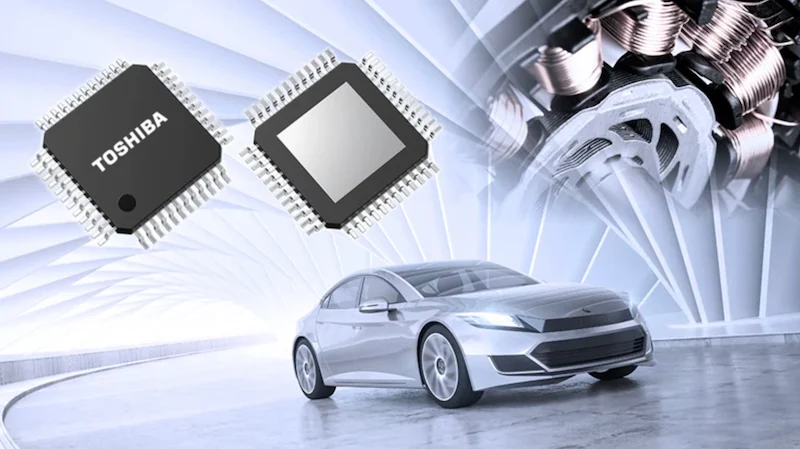
Toshiba designed the TB9M030FG for automotive electric pumps and fans, as well as three-phase brushless motor control and drive. Image used courtesy of Toshiba
In that context, the TB9M030FG offers a highly integrated solution that consolidates a 32-bit Arm Cortex-M0 microcontroller unit, a multi-channel gate driver, and a dedicated hardware vector engine into a single package.
High Integration for Low-Speed Sensorless Control
The TB9M030FG device (datasheet linked) drives external N-channel MOSFETs via an integrated six-channel gate driver that includes a charge pump to maintain sufficient voltage for high-side gate control. Operating between 6.0 V and 18 V, this architecture features a 40-MHz Arm Cortex-M0 processor to manage high-level application logic, while a dedicated Vector Engine (VE) hardware block offloads complex motor control calculations.
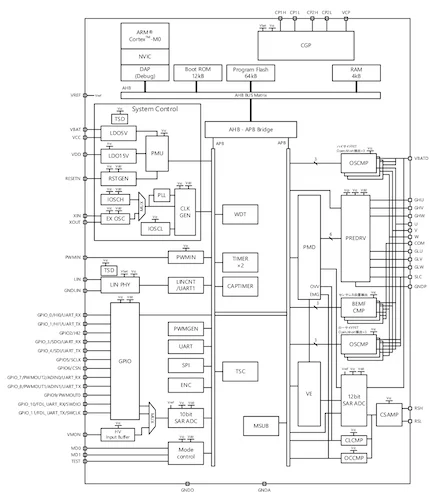
Block diagram of the TB9M030FG. For an enlarged image, see page 3 of the datasheet. Image used courtesy of Toshiba
With the VE, engineers can implement field-oriented control (FOC) tasks, such as coordinate-axis transformations and sine/cosine calculations, without consuming significant CPU cycles. To deliver precise motor control without physical hardware, the device also incorporates proprietary sensorless control technology that determines motor position even at low speeds. To meet the communication and memory needs of such an integrated system, the device also features 64 KB of code flash memory, 4 KB of SRAM, and a LIN ISO17987/SAEJ2602 transceiver to improve communication within the vehicle's network.
Vector Control in Brushless DC Motors
Vector control, or FOC, is a sophisticated method for controlling the torque and speed of three-phase motors by treating the stator currents as vectors. In a standard brushless DC motor, the magnetic field of the rotor must stay synchronized with the magnetic field of the stator to produce efficient motion. Conventional trapezoidal control methods switch between stator phases in discrete steps, which can lead to torque ripple and acoustic noise. In contrast, FOC continuously adjusts the amplitude and phase of the stator currents to maintain the optimal 90-degree angle between the stator and rotor magnetic fields.
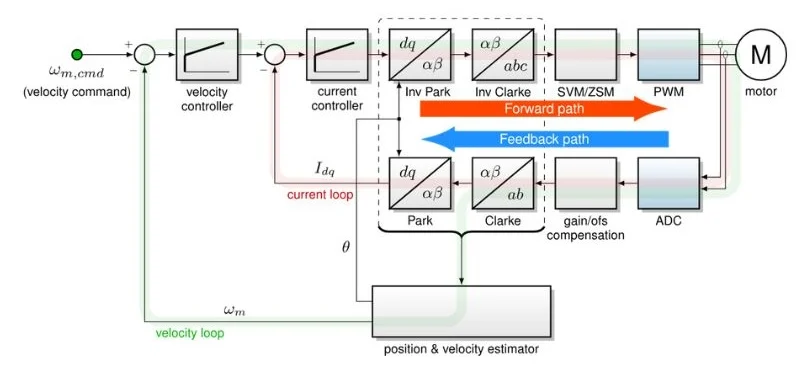
FOC block diagram example. Image used courtesy of Microchip
This process requires intensive mathematical operations performed in real-time. The system must first measure the three-phase currents and transform them from a stationary frame into a rotating frame, a process known as the Clarke and Park transformations. Once in the rotating frame, the currents are split into two components: one that generates torque and one that controls the magnetic flux.
By independently regulating these components with proportional-integral controllers, the system can precisely control motor behavior. After the calculations, the system performs an inverse transformation to convert the control signals back into three-phase, pulse-width modulation outputs. By maintaining a smooth, sinusoidal current flow, FOC significantly reduces energy losses and mechanical vibration.
Future Impact on Automotive Electrification
Toshiba currently offers engineering samples of the TB9M030FG to automotive manufacturers and tier-one suppliers, with the device qualified for AEC-Q100 Grade 0 environments for reliability at junction temperatures up to 175°C.