
Microchip Technology has released version 3.0 of its VectorBlox Accelerator SDK, a free toolkit for deploying convolutional neural networks (CNNs) on the company's PolarFire FPGAs and SoCs.

The latest update employs sparse neural networks to improve edge AI on PolarFire FPGAs and SoCs.
The update's headline feature is sparsity-based model compression, technology that arrived with Microchip's 2024 acquisition of Neuronix AI Labs. The company says this technology makes edge AI practical in power-constrained, mission-critical applications such as aerospace and defense. It targets vision workloads, including image classification, object detection, and semantic segmentation.
From Trained Model to FPGA Fabric
VectorBlox sidesteps the traditional pain point of FPGA-based AI: the need to redesign fabric logic every time the model changes. The SDK works with CoreVectorBlox, an overlay architecture instantiated once in the FPGA fabric. The IP combines a vector processor for general neural network operations with a dedicated CNN accelerator for convolutional layers, connected through a configurable 64-bit to 256-bit AXI4 memory interface. Because the overlay is fixed, new models are deployed as data rather than as hardware, with a single core being able to hold multiple networks and switch between them dynamically, letting one device consolidate several vision or sensor AI functions.
The toolchain accepts models from TensorFlow, TensorFlow Lite, ONNX, and OpenVINO. Quantization tools convert 32-bit floating-point models to INT8, and compilation tools generate binary large objects (BLOBs) that are stored in nonvolatile memory, typically SPI flash, and loaded into DDR at power-on.
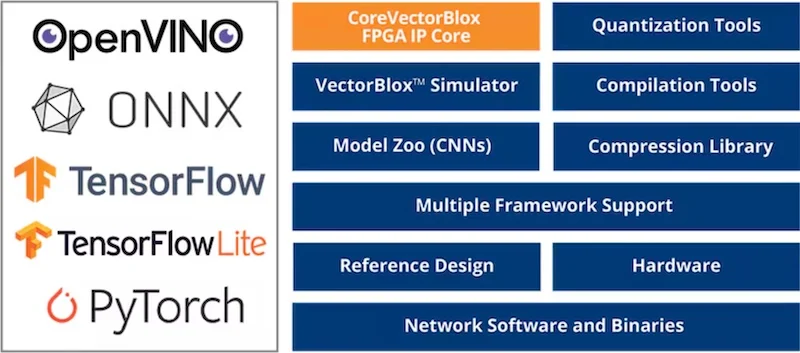
The VectorBlox Accelerator SDK provides AI/ML Inference for PolarFire products.
Microchip quotes complete inference and video pipelines running below 5 W. Both the SDK, hosted on GitHub, and the CoreVectorBlox IP are free of charge, with the IP license generated alongside a Libero SoC Silver license. For hands-on evaluation, Microchip offers the PolarFire SoC Video Kit, which pairs a MIPI CSI-2 camera input and HDMI I/O with an image signal processing pipeline and a VectorBlox reference design.
The release continues a steady cadence for the toolchain. The original VectorBlox SDK arrived with PolarFire's initial push into edge AI, and version 2.0 added a TensorFlow Lite-based flow. Version 3.0 is the first release built around the Neuronix compression technology.
Sparsity as a Compression Strategy
Trained neural networks are full of zero-valued weights and activations that consume compute cycles and memory bandwidth while contributing nothing to the result. Sparse execution skips those operations. Version 3.0 exploits this with two compression modes.
The first is structured compression, which targets regular data such as weights, activations, and feature maps with known layouts, enabling deterministic compression and low-overhead decompression in hardware. The other mode is unstructured compression, which handles irregular data patterns by storing only nonzero values and their indices.
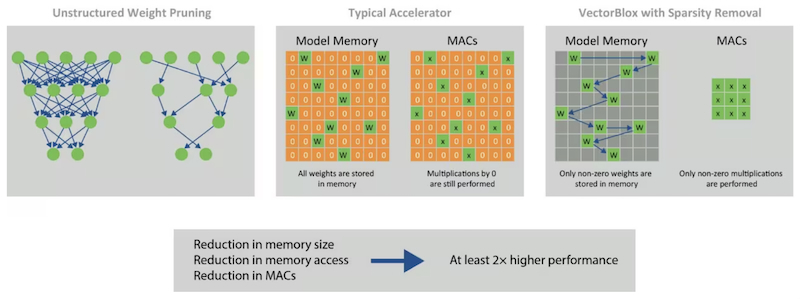
VectorBlox 3.0 reduces memory usage and data movement with structured and unstructured compression.
Microchip's companion webinar puts the gain at up to two-times faster CNN inference on PolarFire SoC FPGAs. Just as important for edge designers, compression lets larger models and higher-resolution data operate within the fixed math-block, memory, and bandwidth budgets of a mid-range FPGA.
Low Power, High Reliability, and a Track Record in Orbit
PolarFire devices store their configuration in nonvolatile flash cells rather than SRAM, making them immune to configuration upsets from radiation-induced single-event effects and eliminating the boot-time bitstream load. Microchip's product literature claims the architecture draws up to 50% less power than comparable SRAM-based FPGAs. Combined with secure boot and anti-tamper protection, those traits explain why the platform's earliest AI adopters operate in orbit.
Planetek Italia used VectorBlox on PolarFire SoC to run onboard Earth observation pipelines, including object detection and semantic scene analysis, aboard the AI-eXpress-1 satellite deployed in 2025. Space AI company AIKO validated its clear_CHARLES suite, which performs onboard cloud and ship detection for autonomous payload operations, on the same combination. Microchip also cites the Spacecraft Pose Network v2, a vision-based pose estimation system for autonomous rendezvous and docking, as a PolarFire-based design.
All images used courtesy of Microchip.