
Recently, Melexis expanded its Triphibian pressure sensor family with three low-pressure variants, which measure configurable spans as low as 2 bar in gas and liquid. As cooling systems become more integral to high-power applications like EV battery packs and high-density data centers, engineers need sensors that can directly contact coolants while surviving the corrosion and freeze-thaw cycles imposed by them.
The low pressure variants are available with these three existing pressure sensors: the MLX90830, MLX90833, and MLX90834. With its new set of sensor variants, Melexis hopes to offer engineers a solution that can provide accuracy and reliability while removing the module-level calibration work that low-pressure designs normally require.
The MLX90830, MLX90833, and MLX90834
The MLX90830, MLX90833, and MLX90834 are three factory-calibrated absolute pressure sensors from Melexis that share a single MEMS sensing element. That element is the company’s patented Triphibian technology, a suspended-cantilever MEMS structure that measures pressure in gas, liquid, and frozen media.
While Melexis first introduced Triphibian in the original MLX90830 in 2024, this new announcement adds three new variants to the family that feature low-pressure coverage and digital output options to measure pressures in new media such as coolants.
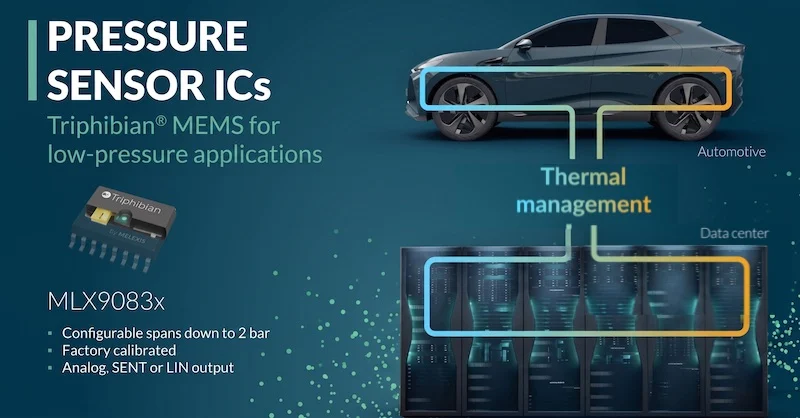
Melexis MLX9083x pressure sensor ICs. Image used courtesy of Melexis.
Within this release, all three variants share the same build and core ratings. Specifically, each sensor pairs the Triphibian element with digital signal processing and an output driver in a SOIC16 wide-body package, holds a 0.5% FS accuracy rating over life, and operates from -40 to +150°C. Melexis factory-calibrates the parts for pressure spans from 0 to 4 bar for low-pressure, and up to 42 bar, depending on the variant.
These variants primarily differ in their output interfaces and ISO26262 functional safety level. For example, the MLX90830 has a ratiometric analog output and is rated at ASIL A, the entry level of the automotive safety standard. The MLX90833 has a digital output using the LIN protocol, making it suitable for automotive systems that network many sensors together.
Like the MLX90833, the MLX90834 also has a digital output, but using the SENT protocol. Both digital parts can also sense temperature through an external NTC thermistor, and Melexis rates them at ASIL B, one level above the analog part.
Measuring Pressure in Liquid and Frozen Media
It's more difficult to measure pressure in a liquid than in air because a liquid can damage the sensor and interfere with its reading.
Take a MEMS pressure sensor, for example. It works by measuring how far a thin silicon diaphragm bends under pressure. Liquids like coolants, refrigerants, and glycol mixtures can corrode that diaphragm or create a pressure difference between the front and back of the die that distorts the reading. Therefore, making a MEMS sensor tolerate such media is a particularly difficult design challenge.
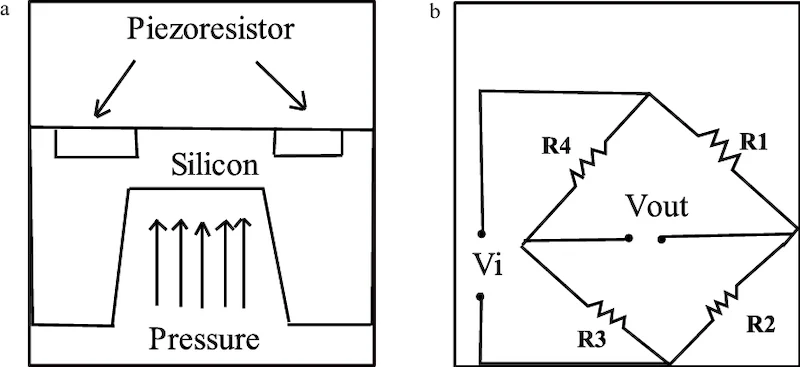
MEMS piezoresistive pressure sensor (a) Schematic cross-section, (b) Wheatstone bridge configuration. Image used courtesy of Suja and co-authors.
The Triphabian approach suspends the sensing element inside the package as a cantilever, with the diaphragm at its tip, so it can sense pressure while shielding the electrical wiring from the medium. Because this design spreads pressure evenly across the structure, the sensor can handle liquid freezing without cracking. The piezoresistive signal it produces is small and shifts with temperature, true of any piezoresistive sensor, and a digital signal processor corrects for it before the chip transmits its reading.
What’s Next?
Melexis hopes these sensors find a home in applications including HVAC-R systems, data center liquid cooling, e-compressors, pumps, and coolant and oil monitoring. All three variants in the Triphibian family are now available for purchase, and Melexis says SPI and I2C options will follow in 2027.