
Microchip recently announced the new SAM9X75D5M system-in-package (SiP) hybrid microprocessor. The new processor bridges the gap between microcontrollers (MCUs) and microprocessing units (MPUs) by integrating 512 Mbit of DDR2, 1 Gbit of DDR3L, or 2 Gbit of DDR3L SDRAM. A 32-bit/16-bit Thumb Arm926EJ-S CPU running at 800 MHz provides the computing power. The three different memory size variants are all pin-compatible.
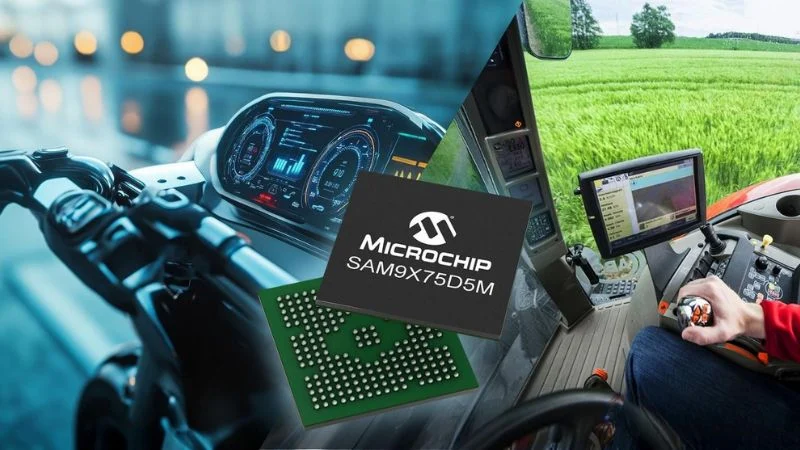
Microchip’s new hybrid automotive MCU, the SAM9X75D5M.
The SAM9X75D5M (datasheet) joins other Microchip hybrid MCU/MPU chips in the AEC-Q100 Grade-2 automotive and e-mobility markets. The new chip, with integrated DRAM, simplifies PCB layout and reduces the overall footprint. The Arm926EJ-S core has hardware support for direct execution of Java bytecode, an important feature for legacy compatibility.
The architecture’s five-stage pipeline and tightly coupled memory (TCM) interface improve deterministic real-time response, even over newer, higher-performance general-purpose MPUs—important for HMI devices. Integrating DDR memory further improves real-time and display-buffering performance. The SiP construction simplifies the hardware design while dropping the bill of materials (BOM) line-item count and reducing printed circuit board area.
A Versatile Tool for HMI
The SAM9X75D5M comes with a robust human-machine interface (HMI) feature set, including a built-in 24-bit LCD controller for displays up to 1,024 x 768 resolution. The MPU has a flexible display connection set including mobile industry processor interface (MIPI DSI), low-voltage differential signaling (LVDS), and 24-bit RGB display interfaces. Connectivity is provided by 10/100/1G Ethernet ports, SPI, high-speed USB, CAN, capacitive and resistive touch interfaces, and up to 13 flexible serial communication controllers (FLEXCOMs).
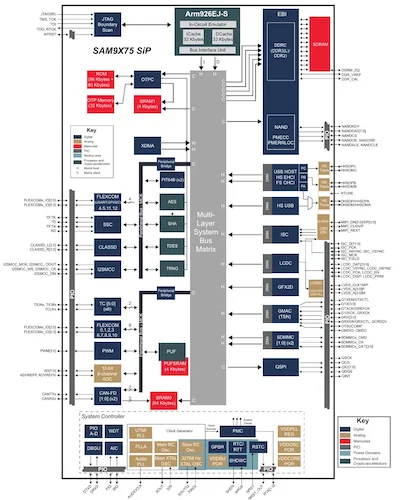
SAM9X75D5M block diagram. (See page 10 of the datasheet for an enlarged image)
Many new smart systems, especially in the HMI arena, are outgrowing the capabilities of even high-end MCUs. These new HMI applications require higher processing power, greater memory density, and support for real-time operating systems (RTOS) that come with an MPU. However, the complexity makes the transition more difficult for the MCU experts who have been designing MCU-based HMIs for years. The SAM9X75D5M addresses all of these challenges with a more friendly architecture than higher-end MPUs, legacy support, and integrated memory.
Bridging the MCU to MPU Gap
The transition from an MCU to a higher-powered microprocessor unit (MPU) is not always easy. In general, MPUs have greater processing power than MCUs and feature an architecture closer to that of a dedicated central processing unit (CPU). MPUs typically lack the on-chip memory and peripherals set that comes with an MCU. Those differences make both the hardware and software design more complex with an MPU than an MCU.
The combination of a powerful processing unit with integrated memory and peripherals in the SAM9X75D5M SiP creates a hybrid that delivers MPU power in a more familiar MCU-style development environment. Software development for the new chip is supported in the MCU-friendly MPLAB X integrated development environment (IDE) and the MPLAB Harmony software framework. It supports FreeRTOS, Eclipse ThreadX, and bare metal MCU-style operation.
Typical SAM9X75D5M Applications
Gone are the days of simple switches and knobs as the primary form of HMI. Today’s vehicles require high-resolution graphics displays with touch input and real-time performance. The SAM9X75D5M is suited for digital cockpit clusters, smart clusters for utility vehicles, HVAC and industrial equipment controls, EV chargers, and more. Advanced hardware security features, including SHA, AES, TDES, TRN, and more, ensure digital safety in these connected application settings.
The SAM9X75D5M SiP 512-Mbit part (Microchip part number SAM9X75D5M-V/4TBVAO) is available now, with 1- and 2-Gbit parts available in sample quantities.
All images used courtesy of Microchip.