
Registered by Motorola in 1962 and the mid-1960s, the 2N2222 and 2N3904 outlasted thousands of rivals through process innovation, cheap packaging, and a JEDEC numbering system that turned them into multi-sourced commodities.
More than 60 years after Motorola Semiconductor first registered them with the EIA, the 2N2222 and 2N3904 are still in volume production from at least half a dozen manufacturers, still stocked by every major distributor, and still the default NPN small-signal transistors used in hobby projects, university labs, and U.S. military supply chains.
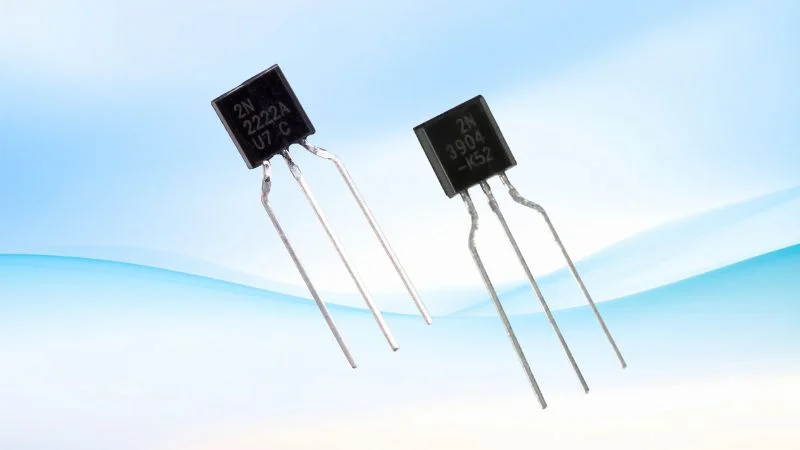
The 2N2222 and 2N3904. Images (modified) used courtesy of Amplified Parts
Almost every other discrete transistor introduced in the same window has long since vanished. The two parts that survived did so not because they were technically superior to their rivals, but because of decisions Motorola made about how to manufacture, package, and license them.
Haenichen's Annular Process
The 2N2222 was the work of Jack Haenichen, a Motorola engineer who joined the company in 1959, when its transistor catalog was still entirely germanium. Haenichen led the team that moved Motorola into silicon NPN production using an improved annular process, which allowed reliable high-voltage operation in a compact die. The family was demonstrated at the IRE convention in March 1962 and registered with the EIA on March 5 of that year. An improved revision, the 2N2222A, followed on February 17, 1964.
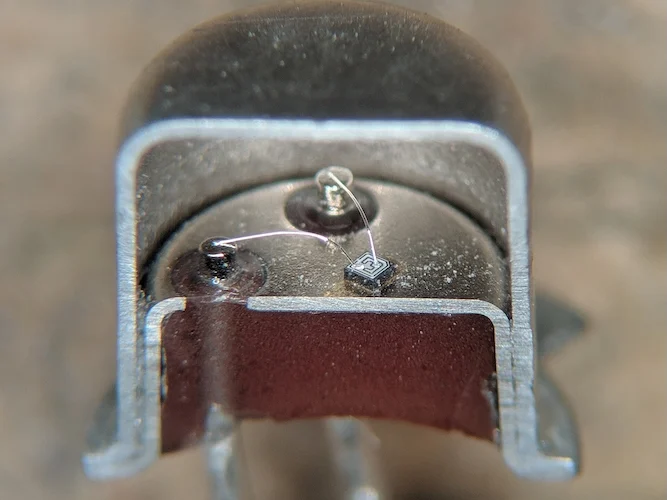
A cross-section of a 2N2222 in a metal TO-18 package, showing connection wires between external pins and the die. Image used courtesy of TubeTimeUS via Wikimedia Commons (CC BY-SA 4.0)
The original device shipped in the TO-18 metal can. It was a low-power, medium-voltage silicon NPN rated at 800 mA collector current with a transition frequency in the hundreds of MHz, fast enough for switching and small-signal RF work. That combination of speed, current handling, and low cost made it the default jellybean NPN almost immediately. The 2N2907 PNP was introduced as a complementary pair, and Motorola's 1963 catalog already listed both devices as preferred parts.
Today, the metal-can 2N2222 is still available from Mouser and DigiKey at around $1.88 per unit, while mil-spec hermetic TO-18 versions sell for upwards of $60 each. The U.S. Department of Defense maintains 22 separate NSNs across the family for radiation-hardened, high-reliability, and standard procurement, supplied mainly by Onsemi and Microchip.
The TO-92 Cost-Down and the 2N3904
If the 2N2222 proved that silicon NPN transistors could be manufactured reliably, the 2N3904 proved they could be manufactured cheaply. Motorola registered it in the mid-1960s alongside the 2N3906 PNP complement.
The key innovation was its packaging. The plastic TO-92 case eliminated the cost of the metal can and the hermetic seal, cutting unit cost dramatically and pushing the part into a market the metal-can 2N2222 could not reach.
The trade-off, however, was capability. The 2N3904 is rated for a collector current of 200 mA, roughly a quarter of the 2N2222's headroom, with a transition frequency of 300 MHz and a collector-emitter rating of 40 V. Its forward gain peaks at a much lower current (around 10 mA, versus 150 mA for the 2N2222), which made it well suited to small-signal amplification rather than switching heavier loads. Together, the two devices covered most of what a designer needed from a general-purpose NPN, and the 2N3904, in particular, became the transistor that every electronics student in the U.S. encountered first.
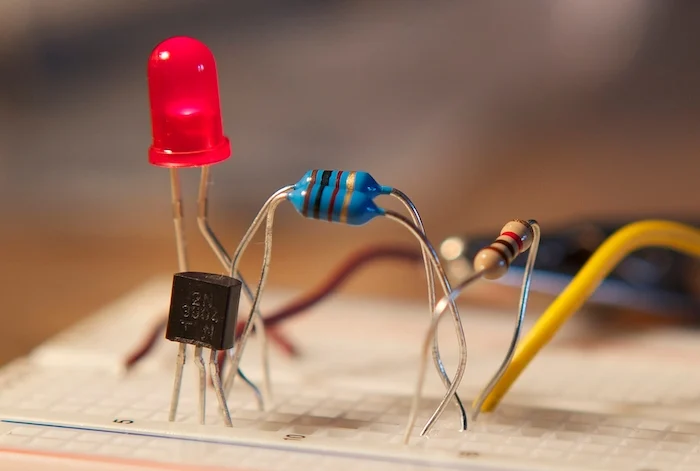
A 2N3904 (lower left) in a TO-92 package on a breadboard. Image used courtesy of Autopilot via Wikimedia Commons (CC BY-SA 3.0)
JEDEC Registration
The reason both parts survived the test of time is the JEDEC registration system. When Motorola registered the 2N2222 and 2N3904 with the EIA, the part numbers became public specifications. Any fab that could meet the rated values was free to ship parts under the same number, and many did. Texas Instruments, Fairchild, Philips, ITT, National Semiconductor, Romania's IPRS Băneasa, and a long list of Soviet and Asian manufacturers all produced their own versions. Soviet clones appeared under domestic numbering schemes; Japanese second-sources went into industrial equipment; Romanian IPRS parts ended up in Eastern Bloc computers.
The result was that no single supplier ever controlled either device, which insulated both from corporate restructuring, fab closures, and product-line discontinuations. When Fairchild was acquired by Onsemi in 2016, the 2N3904 continued shipping. When Motorola spun out Freescale and then sold its discrete business, the 2N2222 kept shipping. Modern SOT-23 surface-mount equivalents now ship from tape-and-reel at fractions of a cent each, while the original TO-18 and TO-92 packages remain available for repair, education, and through-hole prototyping.
That is the real lesson of the 2N2222 and 2N3904. Discrete components don’t survive on performance alone. They survive on standardization, second-sourcing, and the willingness of multiple fabs to keep shipping a part long after its designer has moved on. Motorola got both decisions right in the early 1960s, and the industry has been buying the results ever since.