Today, Palo Alto-based startup Delos Data expanded its Delos Nonstop AI portfolio, introducing the Delos Apollo Data Interface silicon, the Delos Morpheus Platform, and the Delos Nonstop AI Reference Architecture. These new offerings round out the company's existing lineup—including its Delos Mosaic Software showcased at GTC 2026 and Delos Asterion Server presented at Computex 2026—to provide an end-to-end blueprint for low-latency, high-bandwidth inference infrastructure.
As artificial intelligence workloads transition from heavy offline LLM training to continuous, real-time agentic AI inference, data center architectures are running directly into what industry experts call the "Interconnect Wall". According to the company ,modern AI accelerators spend significant computational cycles idling while waiting for data transfers across fragmented networks, creating massive underutilization and wasted power. The new products are designed to solve these scaling constraints.
Alongside the product announcement, Delos Data revealed it has raised over $100 million (bringing total funding to $130M+) from deep-tech and institutional investors including Matrix, Playground, Socratic Partners, Capricorn's Technology Impact Fund, Matter Venture Partners, and IAG DYNAMIQ.
To learn more about the company’s news today, we were pleased to speak with Ed Doe, CEO and Cofounder of Delos Data.
The Problem: The Interconnect Wall and Mixture of "X" (MoXI)
Traditional data center networks were engineered for CPU-first workloads and traditional cloud frontends. However, agentic AI inference demands heterogeneous computing platforms—combining GPUs, XPUs, specialized LPUs, CPUs, high-speed memory, and disaggregated flash storage pooled across racks.
Delos Data defines this paradigm shift as a Mixture of "X" Infrastructure (MoXI), where a single AI workload relies on a complex mixture of diverse hardware, multi-modal AI models, and varied switch topologies and physical link media.
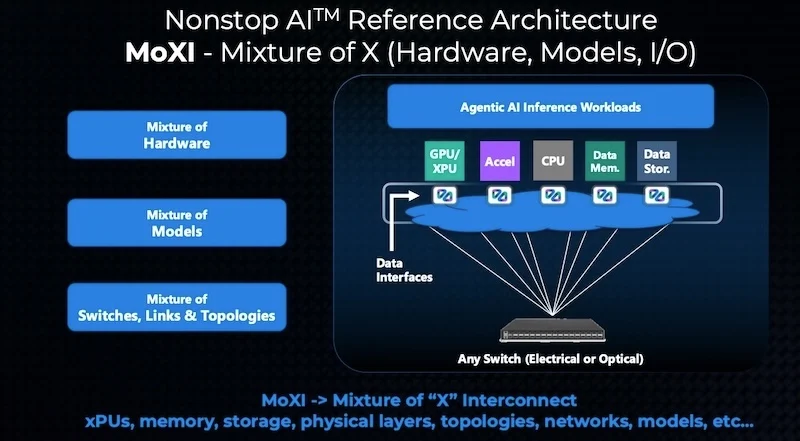
A Mixture of X Interconnect (MoXI) is where an AI workload leverages a diverse mix of technology assets.
Standard scale-out networking protocols deliver bandwidth in the 1–5 Tbps range with microsecond-level tail latencies. In contrast, scale-up AI interconnects require tens of terabits per second with nanosecond-level deterministic latencies to prevent accelerator starvation.
“For these new agentic AI inference workloads, how do you have the right mixture of hardware?” said Doe. “It's no longer one big model. These models effectively have lots of models in them, whether it's mixtures of experts, or different types of modalities inside..Then ultimately, there's a lot of talk about what is the right physical interconnect layer? There's a lot of new innovation happening in just how do you interconnect these together. So it’s a “mixture of X” and you need to interconnect all of it together and build these right clusters. That’s why we acronymize it as MoXI—Mixture of ‘X’ Interconnect."
Inside Delos Apollo: High-Density Silicon for Scale-Up Interconnects
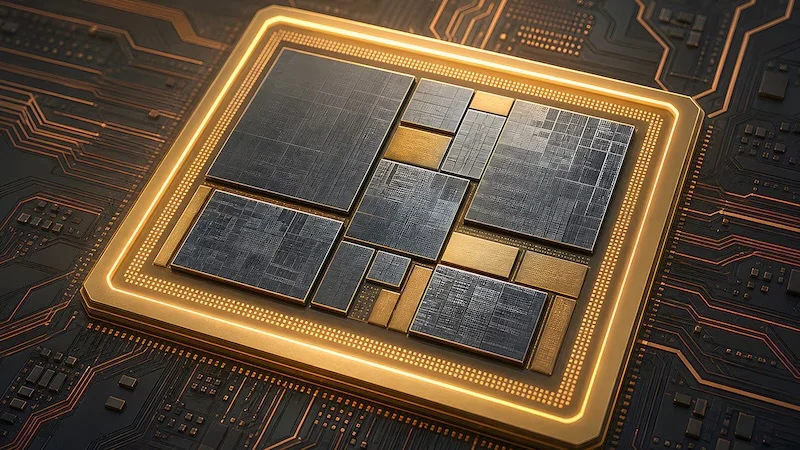
At the center of Delos Data's hardware strategy is the Delos Apollo Nonstop IA Data Interface, a multi-protocol interface delivered in three distinct form factors designed to attach directly to any endpoint across the data domain:
- I/O Chiplet (30+ Tbps): Features multi-protocol support connecting over UCIe to GPUs, XPUs, CPUs, and custom AI accelerators.
- Near-Packaged Optics (10+ Tbps): Integrates the Delos Data Interface logic over UCIe directly to co-packaged optical engines.
- PCIe Card (400+ Gbps): A discrete add-in card bringing CPUs, flash arrays, and disaggregated memory endpoints into the Nonstop AI domain without requiring platform redesigns.
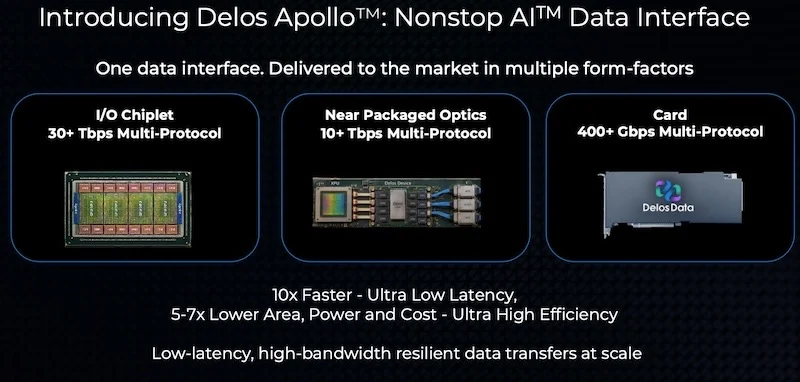
Delos Apollo Nonstop IA Data Interface is offered in three different form factors.
From a silicon design perspective, Apollo achieves extreme density, consuming under 1 sq mm per Tbps of die area in advanced TSMC N2/N3 process nodes. Compared to conventional networking approaches, Delos targets a 10x speedup in latency, a 10x increase in cluster scale, and a 5–7x reduction in silicon area, power, and cost.
“We’ve built that layer that's under 1 square millimeter per terabit,” says Doe. “You can add this without incurring additional latency and using all of the bandwidth, and be able to apply it to all of the bandwidth. That’s opposed to the prior approaches which are probably on the order of 4x to 10x or even larger. Traditional networking approaches probably only get to maybe 1, 2, 3, 4, 5 terabits of bandwidth. Now you're seeing that you have to be talking 10, 15, 20, 30, 40 terabits of bandwidth just dedicated to this new interconnect layer."
Hardware-Level Failure Recovery and Resiliency
In large-scale AI clusters with tens of thousands of endpoints, hardware faults are inevitable. Apollo handles load balancing, network topology mapping, and failure recovery directly in hardware. Sitting between the accelerator die and the physical transport layer, Apollo immediately detects downstream link or node failures and re-routes traffic instantly—delivering hitless failover without crashing or draining active training or inference jobs.
According to the company, most of these engines spend most of their time waiting to be fed, and when you're stitching together endpoints from different vendors at this scale, you can't engineer failure away. Instead, you have to build for it from the beginning. Doing all this boosts efficiency and frees up capacity faster.
Co-Designing Infrastructure with Delos Morpheus
To accelerate adoption and enable pre-silicon co-design, Delos Data also launched the Delos Morpheus Nonstop AI Platform. Morpheus provides a complete hardware and software development kit for frontier AI labs, hyperscalers, and neocloud providers to evaluate infrastructure performance prior to tape-out or hardware deployment:
- FPGA-Based Data Interface: A PCIe development board for running real AI workloads across various network topologies.
- RTL IP Core: Synthesis-ready soft IP implementing end-to-end reliable Layer 4 transport for integration into pre-silicon simulation and emulation environments.
- SystemC Modeling Suite: A cycle-accurate simulation framework for modeling cluster scale up to hundreds of thousands of devices, evaluating failure modes, and tuning congestion control algorithms.
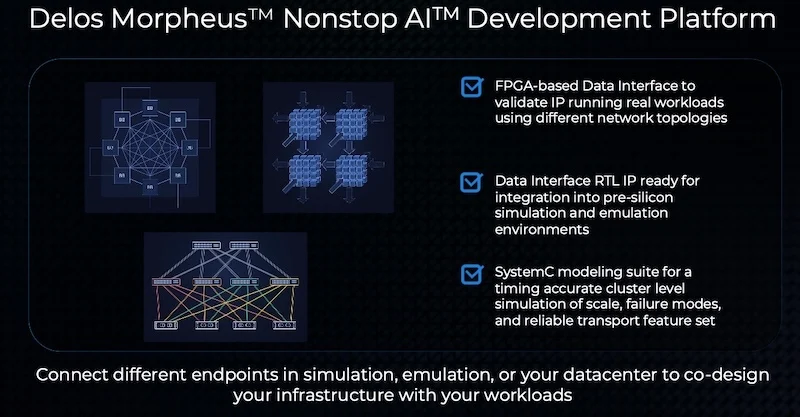
Delos Morpheus Nonstop AI comprises a PCIe card, data interface logic, and a SystemC Modeling Suite.
Morpheus is protocol and media-agnostic, supporting a wide spectrum of physical transport options—including copper cabling, pluggable optics, co-packaged optics (CPO), NVLink, UALink, UALoE, ESUN, MRC, and Ultra Ethernet (UEC).
Availability and Industry Impact
Delos Data’s architectural approach allows data center operators to build unified scale-up domains using standard servers—expanding single-domain topologies from 144 GPUs today to 576 GPUs in next-generation deployments, and ultimately scaling up to 100,000+ endpoints.
According to the company, here is the current status of the Delos Nonstop AI product ecosystem:
- Delos Mosaic Software: In production today with select customers on existing AI clusters.
- Delos Morpheus Platform: Available immediately for pre-silicon co-design and emulation.
- Delos Asterion Server: Open Rack v3 (ORv3) compliant server architecture scheduled to sample to customers in Q4 2026.
- Delos Apollo Silicon: Live demonstrations featured at AI Infra Summit 2026 in Booth #1344.
By unifying hardware interfaces, transport protocols, and software resiliency into a cohesive architecture, Delos Data aims to eliminate the interconnect bottleneck and dramatically lower the cost per token for next-generation AI infrastructure.
All images used courtesy of Delos Data.