
Microchip Technology has expanded its atomic clock portfolio with the Space CSAC-SA65, a radiation-tolerant, chip-scale atomic clock (CSAC) announced. Designed for satellite systems in low Earth orbit (LEO), the device consumes less than 120 mW, occupies less than 17 cc, and provides spacecraft with a precise onboard timing reference that continues to operate when external references such as GNSS are unavailable.

Microchip designed the Space CSAC-SA65, one of the lowest-power atomic clocks, to withstand radiation, so even the smallest CubeSats can now fly with atomic accuracy.
The launch targets the New Space market, where short-duration missions for satellite-to-cellular communications, alternative navigation, and Earth imaging are driving demand for smaller, less expensive hardware than traditional radiation-hardened equipment. Microchip positions the CSAC-SA65 as a compact, low-power alternative to conventional space-grade oscillators, helping developers cut size, weight, power, and cost without sacrificing accuracy.
Atomic Accuracy in a Matchbox-Sized Package
Inside every CSAC, a miniature physics package uses a semiconductor laser to interrogate cesium atoms in a vapor cell, disciplining a quartz oscillator to the atoms' hyperfine transition frequency. The approach delivers the stability of an atomic reference at a small fraction of the size and power of rubidium or cesium-beam standards.
Microchip's commercial SA65, on which the space version builds, measures 41 mm x 35 mm x 12 mm and specifies short-term stability (Allan deviation) below 3 x 10⁻¹⁰ at one second, with a maximum frequency change of +/-3 x 10-10 due to temperature variation, according to the company's product documentation.
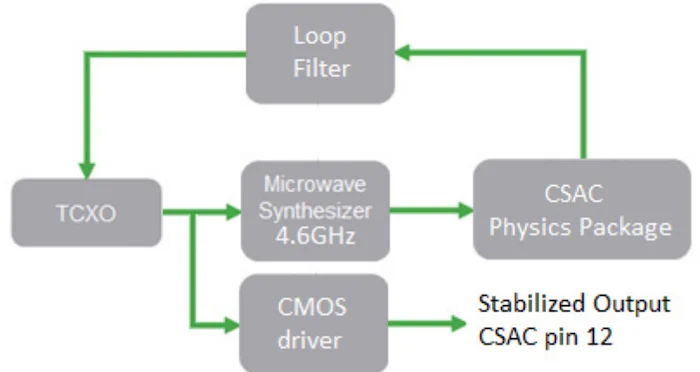
Simplified CSAC block diagram.
The Space CSAC-SA65 includes a built-in one pulse-per-second input and output. The input allows the clock to be disciplined to an external reference when one is available, while the output distributes precise timing to the rest of the satellite. When the external reference disappears (whether due to jamming, spoofing, or orbital geometry), the clock's atomic stability allows the spacecraft to maintain synchronization and timing accuracy on its own for extended periods without continuous reliance on GNSS. Precise onboard time underpins nearly everything a modern smallsat does, from scheduling time-division communication links and timestamping sensor data to maintaining coherence across a constellation.
Hardened for Orbit, Built From Commercial Parts
Compared with the first-generation Space CSAC-SA45, the new device extends radiation tolerance to at least 30 krad of total ionizing dose and widens the operating temperature range to −40°C to 80°C. Microchip describes the CSAC-SA65 as a drop-in replacement for its predecessor, so existing designs can adopt it without hardware or software changes.
Rather than using a dedicated radiation-hardened process, Microchip manufactures the device as a commercial off-the-shelf (COTS) product built from radiation-tolerant commercial components. The company says this approach offers shorter lead times and lower overall costs than traditional space-grade oscillators, both significant factors for constellations built around many small, short-lived satellites.
From DARPA Program to CubeSat Payloads
The CSAC traces its lineage to a DARPA-sponsored program that produced the first chip-scale atomic clock demonstrations at NIST in 2004. Symmetricom commercialized the technology in 2011 with the cesium SA.45s, a 16 cc, 35 g unit drawing roughly 115 mW, with a physics package smaller than 1 cm3.
On the ground, the SA.45s and its successors found homes in GPS-denied navigation, military manpack radios, and underwater and seismic sensing—applications where a stable local clock bridges timing gaps. The product line passed to Microsemi when it acquired Symmetricom in 2013 and then to Microchip with its 2018 acquisition of Microsemi. Microchip says its space CSAC was the industry's first commercially available radiation-tolerant, chip-scale atomic clock.
For the CSAC-SA65, Microchip cites LEO applications including satellite timing and frequency control, satellite clock references, assured positioning, navigation, and timing (PNT), and satellite cross-linking. The company supports the device with its Clockstudio software for control and analysis, as well as a CSAC developer kit.