
The expanded maXTouch M1 family delivers reliable capacitive sensing from compact automotive displays to ultra-wide free-form screens.
Recently, Microchip Technology announced an expansion of its maXTouch M1 family of automotive touchscreen controllers. The new devices, the ATMXT3072M1-HC and ATMXT288M1, are designed to support emerging OLED and microLED display technologies while handling the electrical and mechanical challenges associated with large and small touchscreens.
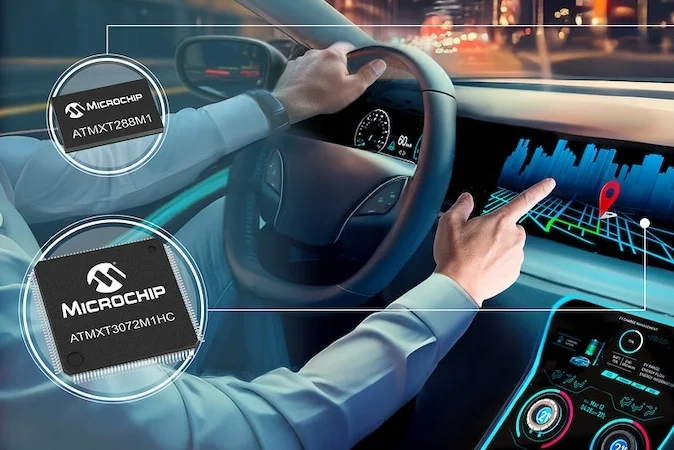
The ATMXT3072M1-HC and ATMXT288M1 controllers are suited for both large and small automotive touchscreens. Image used courtesy of Microchip.
maXTouch M1 Touch Controller Architecture and Device Capabilities
The core of the ATMXT3072M1-HC and ATMXT288M1 is Microchip’s proprietary charge-transfer acquisition engine and Smart Mutual capacitive sensing technology. Microchip’s platform augments mutual capacitance measurements with advanced signal processing to improve touch signal-to-noise ratio (SNR) by up to 15 dB compared with previous maXTouch generations. With higher SNR, the controllers can support more reliable touch detection on displays with high capacitive loads and strong noise coupling, such as on-cell OLED panels.
According to Microchip, the ATMXT3072M1-HC is best for large, continuous touch sensor designs that span multiple display regions, such as a combined instrument cluster and center information display. The solution uses a host-client architecture in which multiple identical devices operate together but present themselves as a single maXTouch controller to the host MCU.
This arrangement obviates the need for an external microcontroller to merge touch coordinates and supports up to 224 configurable sensing channels. With appropriate electrode pitch, the controller can support displays up to 38.5 inches in a 5:1 aspect ratio, with larger formats possible using alternative sensor designs.
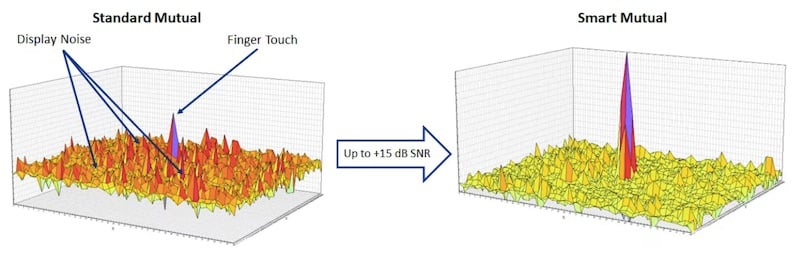
Microchip’s proprietary Smart Mutual acquisition technology enhances touch SNR by +15 dB without increasing the Tx drive voltage. Image used courtesy of Microchip.
For compact screens, the ATMXT288M is the first controller in the M1 family offered in a Thin Profile Fine-Pitch Ball Grid Array (TFBGA60) package. Measuring 8 x 5 x 1 mm, the ATMXT288M reduces PCB area by roughly 20 percent compared to earlier automotive-qualified maXTouch devices.
The controller accommodates non-rectangular sensor geometries and supports up to 288 sensing nodes using 12 transmit and 24 receive lines. According to Microchip, the ATMXT288M’s small size makes it best suited for integration behind thin OLED or microLED panels.
Both new controllers support multiple simultaneous touch points, configurable scan rates, and moisture compensation features.
Noise in Automotive Touch Systems
The main obstacles to capacitive touchscreen performance in automotive systems are electrical noise and mechanical integration.
Large displays, which are becoming more common in the automotive industry, introduce higher parasitic capacitance due to their increased surface area and longer electrode traces. This in turn reduces touch sensitivity and increases susceptibility to noise from display driving signals, power electronics, and ambient electromagnetic interference. To make matters more complicated, emerging screen technologies (on-cell OLED and microLED) intensify coupling between the display stack and the touch sensor.
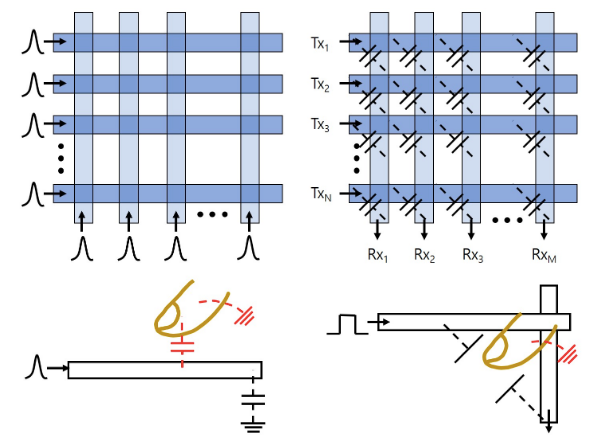
Diagram showing self-capacitance (left) and mutual capacitance (right) touchscreen methods. Image used courtesy of Nam and co-authors.
To respond to these changes, modern automotive touch controllers rely on adaptive sensing techniques. The two basic capacitive touchscreen methods are mutual capacitance and self-capacitance. Mutual capacitance measurements detect changes between intersecting electrodes, while self-capacitance measurements reference electrodes to ground to identify absolute capacitance changes.
By combining the two methods, controllers can distinguish valid touch events from noise sources such as conducted interference or moisture.
Outlook for Automotive Display Platforms
To support new designs with these controllers, designers can use Microchip’s maXTouch development tools. Controllers across the maXTouch family are also supported by the company’s maXTouch Studio for tuning and maXTouch Analyzer for production testing, along with host driver support for automotive and embedded operating systems.