

As AI data centers scale, the primary constraints have shifted from raw compute to the systems that feed and connect them. In early June, three startups put forward products that each target one of those limits.

Oriole Networks' founders. Image used courtesy of Oriole Networks
Lotus Microsystems, Oriole Networks, and Atomera work in power delivery, optical networking, and RF semiconductors, and each has built its latest release around a single bottleneck created by AI's appetite for current, bandwidth, and high-frequency performance.
Lotus Microsystems Puts Power Under the Processor
Copenhagen-based Lotus Microsystems recently launched vStrata, its first vertical power delivery (VPD) platform. Modern AI accelerators draw kiloampere-class currents, and conventional architectures waste energy across the last inch between the voltage regulator and the processor.
Founded in 2020, Lotus treats power and heat as one problem rather than two. Its proprietary silicon Power Interposer Technology places conversion directly beneath the processor while managing thermal load at the same point. The company says the platform reaches up to 96% point-of-load efficiency, cuts power conversion losses by more than 50%, and lowers operating temperatures by up to 25°C in optimized configurations.
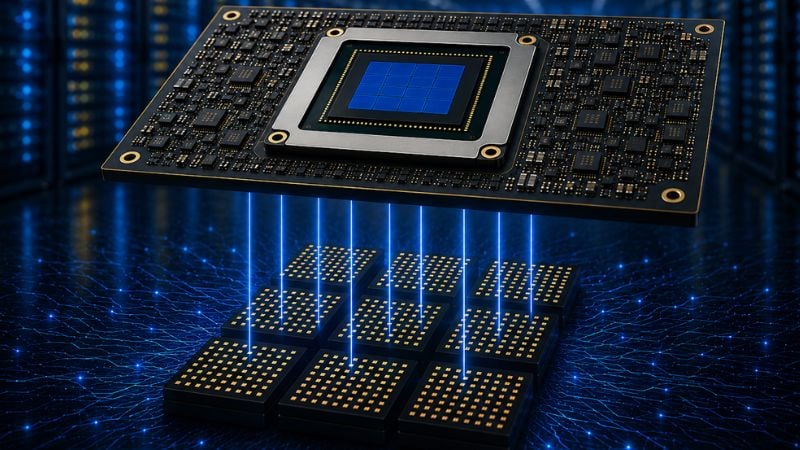
vStrata is a vertical power platform for AI-scale computing. Image used courtesy of Lotus Microsystems
Lotus built the low-profile design (with a roadmap below 1 mm) to handle load transients above 10 A/ns without external capacitors.
The company says it has taped out the LSC0580 as one of the so-called leading xPU and AI infrastructure partners. Lotus is working with Tier-1 hyperscalers through an Early Access Program, with engineering samples of the LSC0580 module due in Q3 2026. It demonstrated the module at PCIM Europe in Nuremberg, held between June 9th and 11th.
Oriole Networks Routes AI Traffic as Photons
London startup Oriole Networks has announced the first commercial deployment of its PRISM photonic networking platform, installed at the U.K.'s ARIA Scaling Inference Lab, a $68 million-backed testbed. PRISM replaces the electronic switches at a network's core with nanosecond-scale optical circuit switching, moving data between chips as photons rather than electrical signals. Oriole's designs are xPU-agnostic.
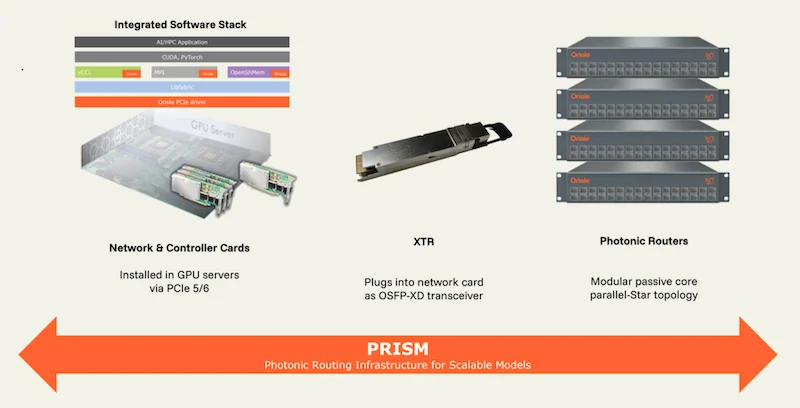
PRISM is a full-stack, all-optical fabric that quickly and simply connects GPUs at scale. Image used courtesy of Oriole
A spinout from University College London founded in 2023, Oriole has raised roughly $35 million. Running alongside AMD Instinct GPUs and EPYC CPUs, the system cuts core network power consumption by 81% and drops GPU idle time from about 60% today to under 1%, according to the company.
AMD is contributing GPU and CPU hardware and helping validate the fabric at frontier scale; Madhu Rangarajan, AMD's corporate vice president for Compute and Enterprise AI, called nanosecond optical circuit switching "a fundamentally different way to connect accelerators at scale." The deployment runs as part of a collaboration with AMD that has been underway for more than a year. The company plans a wider industry rollout in 2027.
Atomera Brings GaN Performance to Silicon
Silicon engineering company Atomera has announced a process to make gallium nitride (GaN) RF devices cheaper to build. High-performance RF GaN is usually grown on silicon carbide, which performs well but stays costly and hard to scale. GaN-on-silicon offers a lower-cost, more scalable base, yet parasitic channel charge at the device interface has historically held back its RF performance.
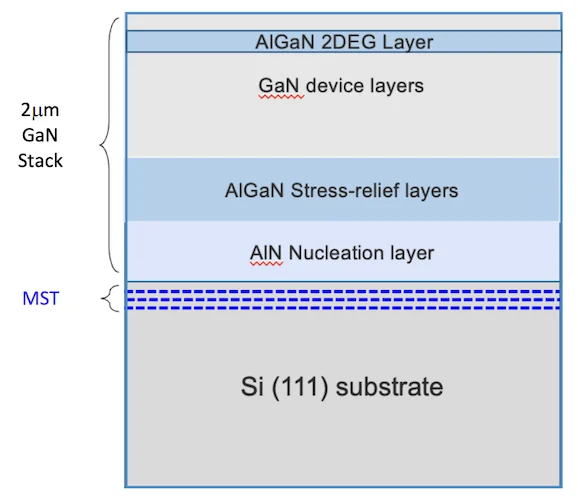
Schematic of an RF GaN-on-Si wafer. Image used courtesy of Atomera
Atomera says its MST technology, an engineered film of silicon and oxygen inserted during fabrication, reduces parasitic channel charge by more than 10x while preserving linearity under power stress. Linearity is key because RF front ends must amplify signals without distorting them. The company says its test data shows devices handling significant power while holding signal quality.
That combination opens GaN-on-silicon to 5G, future 6G, and other high-frequency uses. With Atomera's MST removing barriers to GaN-on-silicon-based RF systems, the company is presenting a cheaper substrate stand-in for parts that have leaned on more expensive materials.
AI Scaling From Around the Chip
The three announcements share a pattern: none is a faster processor. Each instead targets a supporting system that AI scaling has pushed to its limit—delivering current at the package, moving data between accelerators, and producing high-frequency RF on affordable silicon. As compute density climbs, more of the demanding engineering sits around the chip rather than inside it.