Nordic Semiconductor has expanded its nRF54L Series with the nRF54LC10A, an entry-level multiprotocol System-on-Chip (SoC) for compact, cost-sensitive IoT devices. The new chip supports Bluetooth Low Energy (LE), Bluetooth Channel Sounding, Thread, Zigbee, and Matter, along with proprietary 2.4 GHz wireless protocols.
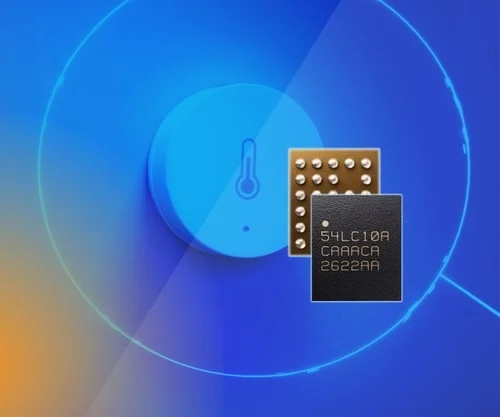
Nordic Semiconductor’s nRF54LC10A brings multiprotocol wireless connectivity to compact, battery-powered IoT devices.
The nRF54LC10A is the smallest ultra-low-power multiprotocol SoC in Nordic's nRF54L Series. It combines a 128 MHz Arm Cortex-M33 processor, a RISC-V coprocessor and a multiprotocol radio in package options that include a 1.9 × 2.3 mm chip-scale package. Nordic is targeting Bluetooth trackers, item finders, tags, smart home sensors and other connected products where board space, power consumption and cost are important.
Keeping the Size Down Without Cutting Connectivity
Entry-level wireless devices often have limited memory, processing capability, or protocol support to keep costs down. Nordic's approach with the nRF54LC10A is to provide the core features of its larger nRF54L devices while using a smaller package and a peripheral set suited to simpler applications.
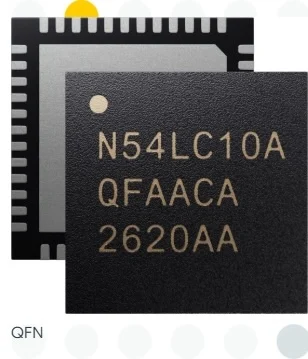
The nRF54LC10A is available in chip-scale and QFN package options for space-constrained IoT designs.
The chip includes 1 MB of nonvolatile memory and 192 KB of RAM, along with three configurable SPI/TWI/UART peripheral instances and an ADC. Its Cortex-M33 processor delivers a preliminary 503 CoreMark score and 239 CoreMark/mA. The device is manufactured on a 22 nm process and uses Nordic's low-leakage RAM and multiprotocol radio architecture.
Wireless support covers Bluetooth LE, including Bluetooth Channel Sounding for distance measurement, as well as Thread, Zigbee, and Matter for simpler connected devices. Proprietary 2.4 GHz protocols are also supported at data rates up to 4 Mbps. This allows developers to use the same SoC across different types of connected products rather than selecting a separate wireless platform for each protocol.
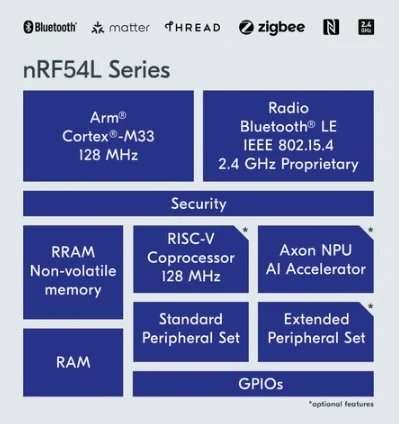
Nordic’s nRF54L Series architecture combines an Arm Cortex-M33 processor, multiprotocol radio and security features.
The nRF54LC10A also runs the same qualified wireless stacks, embedded software, and development tools as the rest of the nRF54L Series. That makes it easier to move between devices in the family if a product needs additional resources later. More information can be found in the nRF54LC10A data sheet.
Low Power for Battery-Operated Devices
Power consumption is another important part of the nRF54LC10A, particularly for products that may spend most of their time waiting for a wireless event. At a 3 V supply, the radio draws 4.0 mA in receive mode and 5.8 mA when transmitting at 0 dBm. Maximum transmit power is +4 dBm, while receiver sensitivity is -97 dBm for Bluetooth LE 1M and -101 dBm for IEEE 802.15.4.
Sleep-mode current ranges from 0.5 µA to 1.6 µA. Nordic also specifies a hibernation mode drawing less than 50 nA, which is particularly useful for products with enclosed batteries that may spend long periods in storage before being activated. The low standby consumption helps preserve battery capacity during that time.
Security and device maintenance are included as well. The nRF54LC10A provides Arm TrustZone isolation and protection against physical attacks. Nordic's nRF Cloud services support firmware-over-the-air (FOTA) updates and remote device monitoring, allowing deployed products to receive software updates and be maintained without physical access.
Targeting Trackers and Smart Home Sensors
Nordic expects Bluetooth LE products to account for much of the nRF54LC10A's use. Asset trackers, item finders and tags are among the main applications, with Bluetooth Channel Sounding providing an additional capability for products that need distance measurements.
Nordic’s nRF54LC10A will also target Thread and Zigbee accessories, along with simpler Matter-enabled sensors that fit within its available memory. In home hubs and Thread Border Routers, it can operate as a Thread radio coprocessor alongside a separate host MCU or application processor.
The nRF54LC10A is available for sampling now, with development kits expected to be generally available by Q1 2027 and production planned for Q2 2027. With its small package, multiprotocol support, low sleep current, and shared nRF54L software platform, the device extends Nordic's wireless lineup to connected products that need a relatively simple MCU without giving up the wireless and security features used elsewhere in the series.
All images used courtesy of Nordic Semiconductor.