Infineon recently introduced a new vehicle cockpit display microcontroller (MCU) that delivers high-performance instrument cluster and heads-up display (HUD) capabilities without adding high cost.
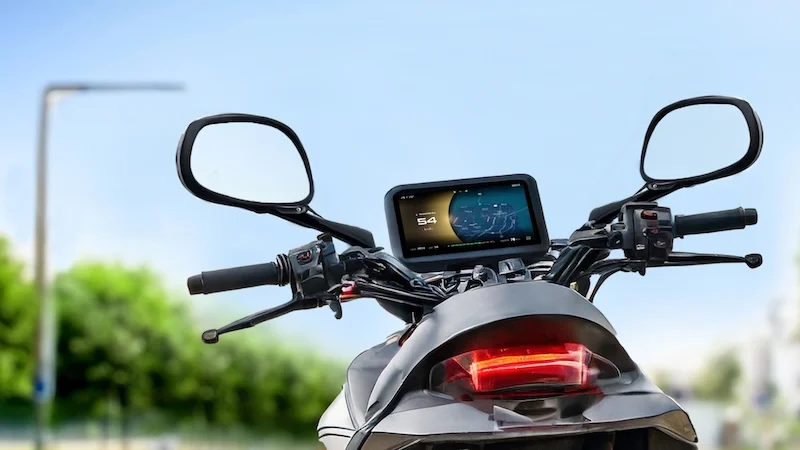
Infineon designed the MCU for automotive and motorcycle cluster displays.
The Traveo T2G CYT4EN MCU features a dual-core Arm Cortex-M7 running at 320 MHz for main CPU functions. It includes an on-chip Cortex-M0+ to offload peripheral and security operations from the main CPU. The MCU separates main memory and utilizes external LPDDR4 to reduce chip complexity and add design flexibility. It delivers 2.5D graphics and 3D scene rendering at full HD resolution on up to two display screens.
Automotive and motorcycle cluster displays differ somewhat from infotainment in that the instrument cluster must always be available and accurate. An infotainment display can get away with a pause here and there, but a speedometer, tachometer, and other critical cluster functions cannot. Infineon designed the dual-core main processor and capable peripheral processor to ensure real-time performance. The display and system processing can’t lag peripherals, and peripherals can’t lag the system.
Key Features of the New Automotive MCU
The Traveo T2G CYT4EN uses a dual Arm Cortex-M7 for heavy lifting and an Arm Cortex-M0+ for peripherals and security, both running at 320 MHz. The main and secondary cores run on independent voltage domains, allowing critical functions to remain alert in low-power modes.
It utilizes external LPDDR4 rather than a large on-chip LPDDR bank. It includes on-chip 6 MB of flash, 640 KB of SRAM, and 128 KB of WFlash. WFlash, or “work flash”, is an independently accessible flash bank used for EEPROM emulation, data logging, calibration information storage, and customization parameters.
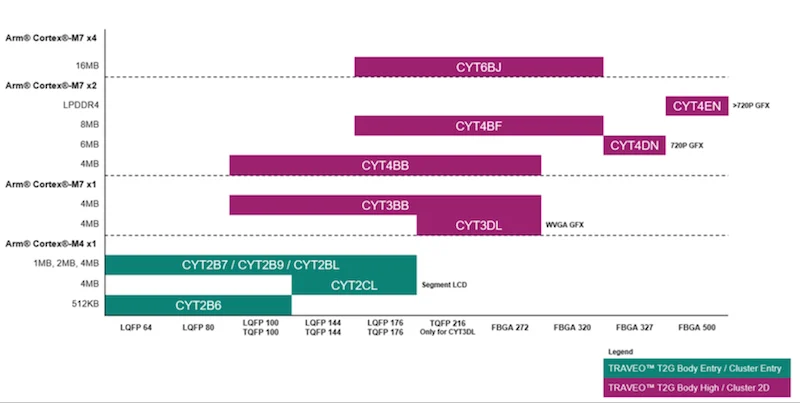
The CYT4EN (upper right) joins a broad family of Infineon instrument cluster microcontrollers.
The MCU comes with a number of display-oriented features, including 1080p native graphics resolution on two displays, a 2.5D rendering engine, and hardware JPEG decoding. It also integrates video input, enabling driver or road monitoring. Sound support includes a dedicated hardware sound module, PCM-PWM, I2S, and a DAC unit. The chip is rounded out with SDIO, CAN FD, Gb Ethernet, up to 40x ADC channels, and up to 113x GPIO.
The CYT4EN supports automotive specifications, including ISO 26262 ASIL-B for capability and reliability and ISO 21434 for automotive cybersecurity, with enhanced secure hardware extension (eSHE) and a hardware security module (HSM).
Designed With Design in Mind
The Infineon design team collaborated with Micron on the LPDDR interface. Micron offers an automotive-targeted LPDDR4 solution that meets ASIL D and complies with ISO 26262. Micron helped the Infineon team optimize the memory subsystem to use LPDDR4 effectively.
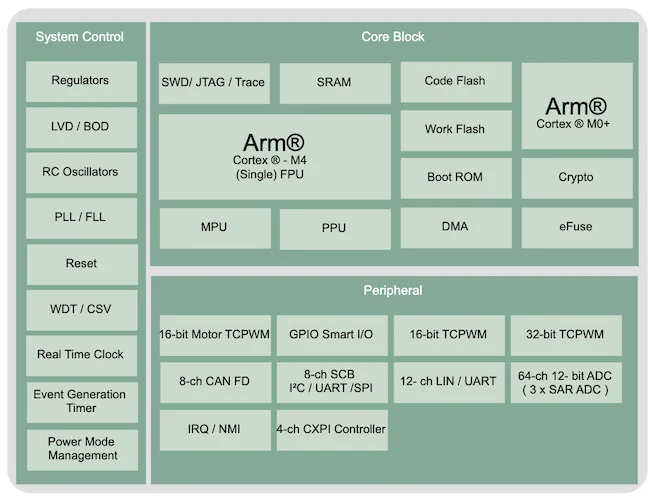
Block diagram of the Traveo T2G.
The external LPDDR4 in the CYT4EN illustrates a slightly different system design approach. Using external main RAM may seem counterintuitive these days, but here it allows greater flexibility in the amount of RAM used. It also reduces the MCU size, cost, and complexity. Including an independent Cortex-M0+ for peripherals, communications, and security management eliminates the need for a multi-MCU PCB design. It also delivers system-on-chip (SoC)-like performance without the added manufacturing cost of a mixed-signal SoC. Infineon aims to support PCB designs with as few as six layers, reducing both build cost and upfront design time.
Application support includes Infineon Drivecore, Autosar, and the Modulous toolbox automotive software. Drivecore is a set of pre-integrated software modules covering Infineon and third-party automotive software. Autosar is a driver layer for the Traveo microcontroller family. Finally, the Modulous toolbox is an extensible development ecosystem for Infineon microcontrollers.
The Traveo T2G CYT4EN is now available for shipment.
All images used courtesy of Infineon.